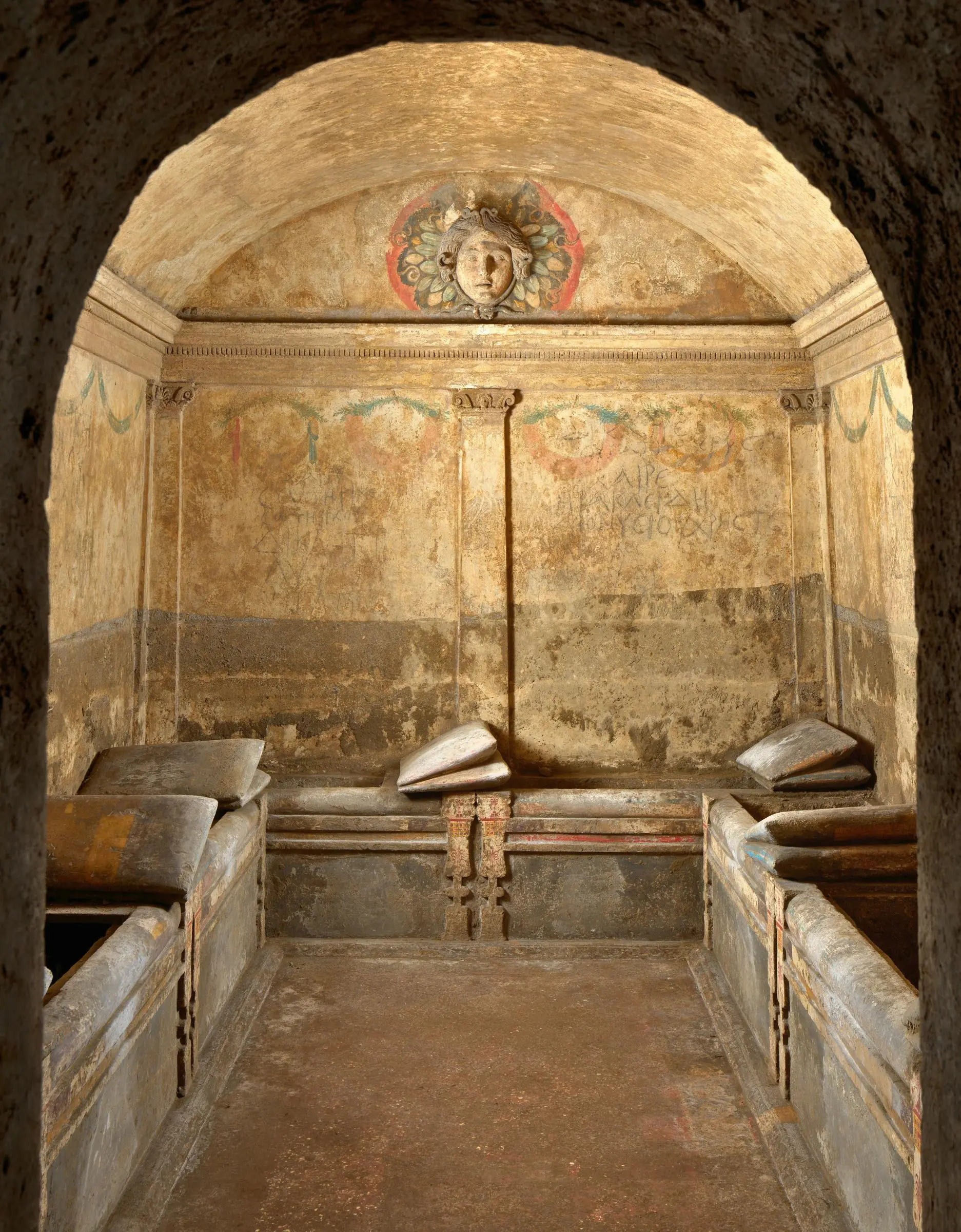
Long before the Romans built their villas around the Bay of Naples, the city was Neapolis—a thriving, powerful Greek settlement. While much of the Roman history is highly visible in places like Pompeii and Herculaneum, the Greek layer of Naples is largely buried.
That is what makes the Hypogeum of Crystallines (Ipogeo dei Cristallini) so significant. Located 40 feet beneath the chaotic, scooter-filled streets of the Rione Sanità, this complex of four Hellenistic burial chambers dates back to the 4th century BC. After being sealed off and privately owned for decades, the site recently opened to the public following an extensive, high-tech restoration.
Because the ancient paint is highly sensitive to changes in humidity and carbon dioxide, access is strictly regulated. You cannot simply walk up and buy a ticket at the door.
To protect the 2,400-year-old frescoes, the Ipogeo dei Cristallini only allows a handful of visitors inside at a time. Walk-ups are routinely turned away. You must secure your entry pass or guided tour days or even weeks in advance.
Is the Hypogeum Right for You?
Before you book, it helps to know if this specific archaeological site aligns with your travel style and constraints.
- For History & Art Buffs: This is one of the most important Greek archaeological sites in Southern Italy. If you have already visited the National Archaeological Museum and want to see Hellenistic art in situ rather than behind glass, this is a priority stop.
- For the Time-Poor: The actual time spent inside the tombs is short (usually around 30 to 45 minutes) due to microclimate restrictions. To make the journey to the Sanità neighborhood worthwhile, plan to combine this with a guided tour of the nearby Catacombs of San Gaudioso.
- For Families with Young Children: Think carefully before bringing toddlers. The descent involves a steep, narrow 19th-century staircase. The environment is quiet, confined, and the walls are incredibly fragile. Strollers cannot be accommodated.
- For Budget Travelers: At around €10 to €12, the entry fee is reasonable for the rarity of the site. To save money, opt for the Standard Entry rather than a private guide, and use the provided informational placards.
5 Highlights of the Hypogeum
The complex consists of four tombs, but they are not all in the same condition. Tomb C is the undisputed star of the site, having survived largely intact. Here is what to look for when you make the descent.
1. The Vivid 2,400-Year-Old Wall Paintings
When you enter Tomb C, the first thing that strikes you is the color. Unlike many ancient ruins where the paint has faded to bare rock, the walls here are saturated with rich Egyptian blue, deep ochre, and vibrant pomegranate red. These frescoes depict garlands, wreaths, and Dionysian symbols. The survival of these pigments is due to the tomb being sealed under layers of mud and volcanic ash for centuries, protecting it from light and air.
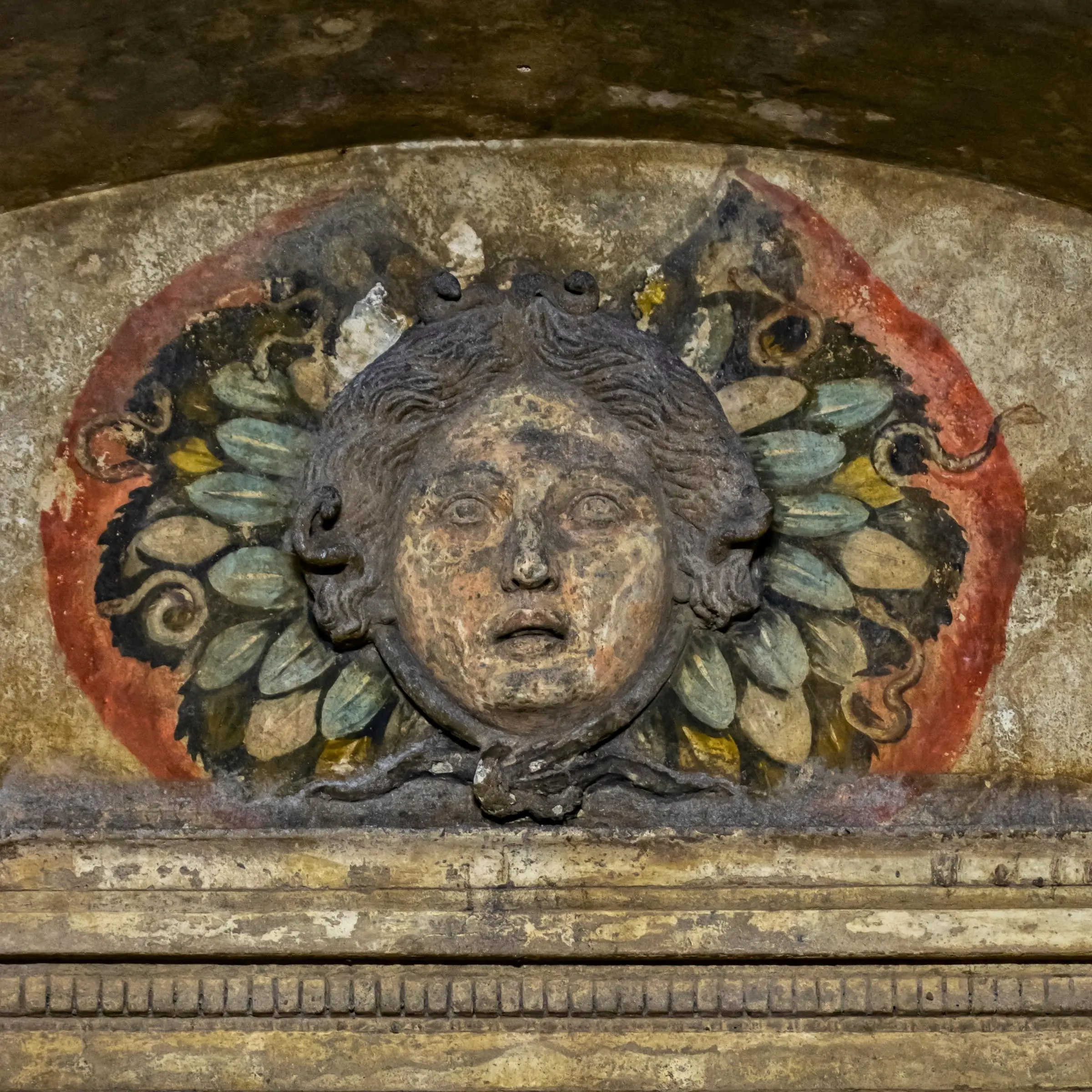
2. The Sculpted Medusa Head
Carved directly into the tuff rock above the entrance to the lower burial chamber is a high-relief sculpture of a Gorgon—specifically, Medusa. In ancient Greek funerary traditions, the Gorgon was an apotropaic symbol, meant to ward off evil spirits and protect the deceased. Her face is painted with striking detail, and her presence in the dim light of the tomb is genuinely imposing.
3. Trompe L’oeil Architecture
The Greeks who built these tombs wanted them to resemble grand, above-ground temples. To achieve this underground, they carved and painted the walls using trompe l’oeil (optical illusion) techniques. You will see painted Ionic columns, faux marble panels, and architectural steps that trick the eye into seeing a three-dimensional temple facade carved into a flat wall.
4. The Sheer Exclusivity of Access
Visiting the Ipogeo dei Cristallini feels entirely different from shuffling through the crowded corridors of Naples Underground. Because groups are capped at just a few people per time slot, you experience the tombs in near silence. This isolation allows you to actually absorb the atmosphere of a space that was designed for quiet mourning and reflection.
5. The Preservation Techniques
The opening of the tombs required a massive feat of modern engineering. As you walk through, you will notice the environmental sensors and the specialized lighting system. The lights are designed to emit zero heat and specific wavelengths that will not degrade the ancient pigments. The airlocks and restricted visitor times are all carefully calculated to keep the internal humidity and temperature exactly where it needs to be to prevent the paint from flaking.
How to Get There & Logistics
The Hypogeum is located at Via dei Cristallini 133, right in the heart of the Rione Sanità. This neighborhood is famous for its vibrant street life, baroque architecture, and gritty authenticity.
By Metro: Take Metro Line 1 to Museo or Metro Line 2 to Piazza Cavour. From either station, it is about a 10 to 15-minute walk into the Sanità district.
Walking Route from Piazza Cavour
⏱️ Total: 15 minEnter the Sanità
From Piazza Cavour, cross the busy Via Foria and walk through the Porta San Gennaro. You are now on Via Vergini, the main artery of the neighborhood. Watch out for the constant stream of delivery scooters.
Pass Palazzo dello Spagnolo
As you walk up Via Vergini, look to your right to spot the Palazzo dello Spagnolo, famous for its spectacular double-ramp “hawk-wing” staircase.
Turn onto Via dei Cristallini
Continue straight as Via Vergini turns into Via Arena della Sanità, then take a right onto Via dei Cristallini. The entrance to the Hypogeum is unassuming—look for the specific street number and the small official signage.
Navigating the Sanità: The Rione Sanità is safe during the day, but it is incredibly busy. Sidewalks are narrow or non-existent, and scooters weave through pedestrian traffic. Keep your bags close to your body and stay alert to your surroundings while walking.
Ticket Options & Tours
Because you cannot buy tickets at the door, you need to choose your entry type in advance, whether you prefer a self-guided visit or an Ipogeo dei Cristallini guided tour with a Rione Sanità audio guide.
Ipogeo dei Cristallini: Guided Tour + Audio Guide
- Includes a live guide inside the tombs
- Includes a digital audio guide for the wider Rione Sanità neighborhood
- Best for understanding the historical context of the frescoes
Ipogeo dei Cristallini: Standard Entry
- Timed entry to the burial chambers
- No live guide included
- Good for those who prefer to read the placards at their own pace
Making a Day of It: The Rione Sanità
Since your time inside the Hypogeum is brief, you should plan to spend a few hours exploring the surrounding neighborhood. The Sanità was historically a burial ground (which is why the Greek tombs and early Christian catacombs are here), but today it is one of Naples’ most dynamic districts.
- The Catacombs: Just up the hill from the Hypogeum are the Catacombs of San Gaudioso, located beneath the Basilica of Santa Maria della Sanità. If you want to see how burial practices evolved from the Greek era to the 17th century, book a guided tour here. Further up the hill near Capodimonte are the massive Catacombs of San Gennaro.
- Fontanelle Cemetery: A short walk away is the Fontanelle Cemetery, an old tuff quarry filled with the neatly stacked skulls and bones of plague victims, tied to the local cult of the “pezzentelle” (abandoned souls).
- Local Pastries: You cannot leave the Sanità without stopping at Pasticceria Poppella (Via Arena della Sanità, 29). They invented the Fiocco di Neve (Snowflake)—a soft brioche bun filled with a light, sweet ricotta cream. Expect a short line, but it moves quickly.
Keep Planning: To understand how the Greek artifacts found in these tombs fit into the wider history of the region, read our complete guide to the National Archaeological Museum (MANN).
Where to Stay Nearby
If you want to be close to the ancient sites of the Sanità while remaining connected to the rest of the city, look for accommodation around Piazza Cavour or Via Foria. This puts you right on the border of the historic center (Centro Storico) and the Sanità, with immediate access to Metro Lines 1 and 2.
Frequently Asked Questions
Is the Hypogeum of Crystallines wheelchair accessible?
No. Because the site is an authentic underground archaeological dig, access requires descending a steep, narrow flight of stairs. There are no elevators or ramps available.
Can I take photographs inside the tombs?
Photography policies can be strict to protect the artwork. Generally, photography without flash is permitted, but you must follow the instructions of the staff on site. Tripods and professional equipment are not allowed.
How long does a visit to the Ipogeo dei Cristallini take?
The actual time spent underground is usually limited to 30 to 45 minutes to maintain the delicate microclimate. Including the descent and the introductory information, plan for the entire experience to take about an hour.
Is it cold down in the burial chambers?
Yes, the temperature underground is naturally cooler and more humid than the streets above, usually hovering around 15°C to 18°C (60°F to 64°F) year-round. It is a good idea to bring a light sweater or jacket, even if you are visiting in the middle of summer.
Are the tombs claustrophobic?
The chambers themselves have reasonably high ceilings, but the spaces are confined, and the staircase leading down is narrow. If you suffer from severe claustrophobia, you may find the environment uncomfortable.
Do I need to print my tickets?
No, digital tickets on your smartphone are accepted. Just ensure your screen brightness is turned up when presenting your entry pass to the staff at the entrance.