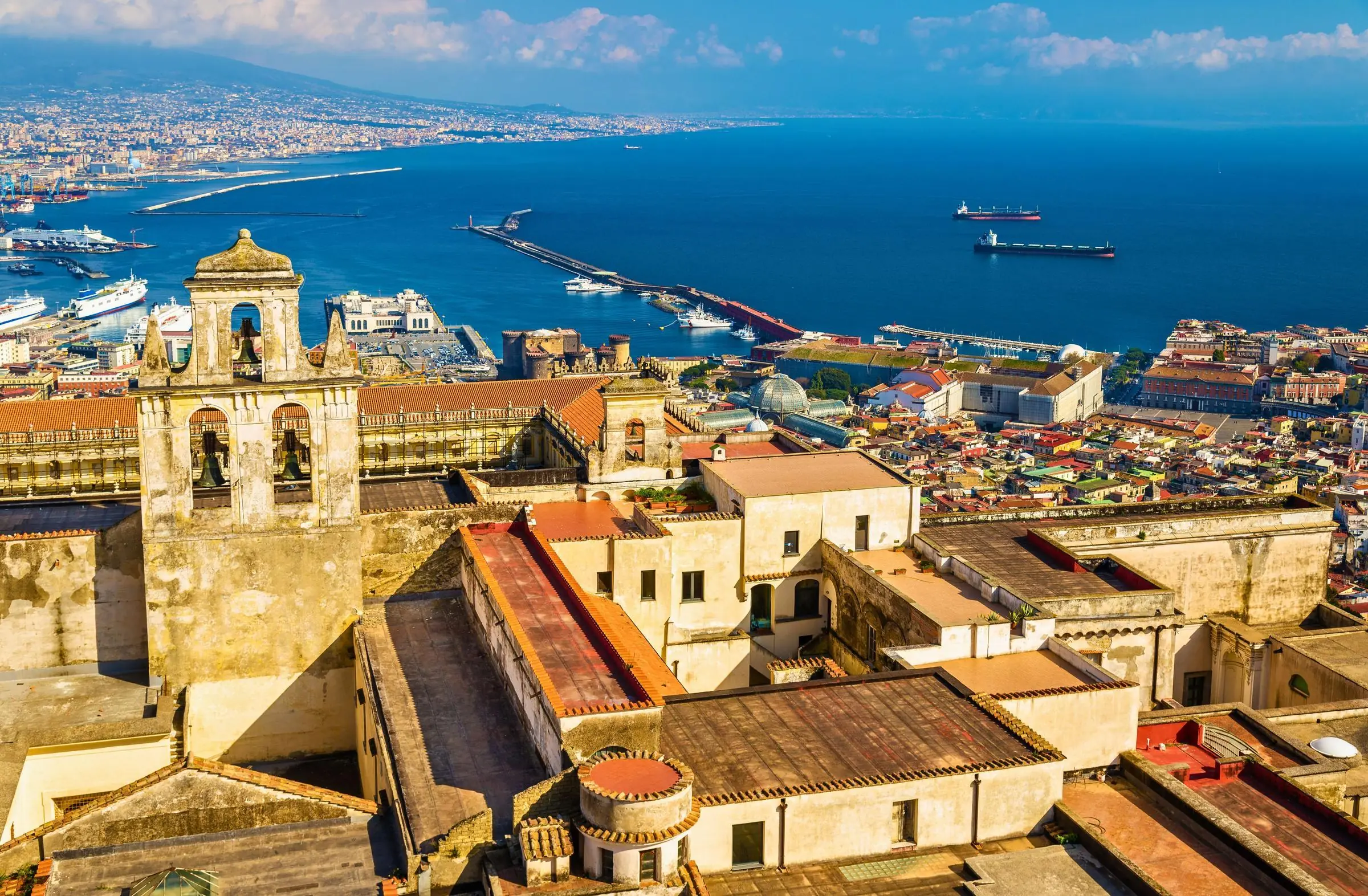
Looming high above the chaotic streets of the Centro Storico, Castel Sant’Elmo is a massive, star-shaped fortress carved directly into the yellow tuff rock of Vomero Hill. While Naples has three major castles, this 14th-century citadel is the one you visit for the views.
Unlike the opulent Royal Palace down by the water, Sant’Elmo is a stark, utilitarian military structure. It doesn’t have furnished royal apartments or glittering chandeliers. Instead, it offers sheer scale, fascinating military architecture, and an uninterrupted 360-degree panorama that lays out the entire Bay of Naples, Mount Vesuvius, and the dense urban grid of the city below.
Whether you are here to trace the lines of Spaccanapoli from above, explore the modern art museum housed in the old officers’ quarters, or simply escape the heat of the lower city, this guide covers exactly how to navigate the fortress and the funiculars required to reach it.
Who Should Visit Castel Sant’Elmo?
Because the fortress requires a bit of an uphill trek (even after taking the funicular), it helps to know how to approach it based on your travel style.
- The Time-Poor: If you only have a few hours in Naples, prioritize this castle. The view from the top provides an instant geographical understanding of the city. You can get up, take your photos, and be back down in the historic center in under 90 minutes.
- Photographers: This is the premier vantage point in Naples. Come in the late afternoon when the harsh midday sun softens, casting a golden glow over Mount Vesuvius and the terracotta rooftops below.
- Budget Travelers: Entry is relatively inexpensive compared to other major European landmarks. If you time your visit for the first Sunday of the month, entry to state museums (including Sant’Elmo) is free, though you will have to deal with heavier crowds.
- Families with Kids: The massive Piazza d’Armi (parade ground) at the top is a great, car-free space for kids to walk around. However, keep a close eye on younger children near the rampart edges, as the drops are sheer.
While Sant’Elmo rarely sells out completely, the physical ticket line at the entrance can move painfully slow, especially on weekends and during the summer. Booking a digital ticket in advance lets you walk straight to the scanners.
How to Get There: The Montesanto Funicular
Castel Sant’Elmo sits at the highest point of the Vomero neighborhood. Do not attempt to walk up from the historic center unless you are looking for a punishing stair-climbing workout. Instead, use the city’s funicular railway system.
The most direct route from the historic center is the Montesanto Funicular.
The Funicular Route to the Castle
⏱️ Total: 25 minBoard at Montesanto Station
The lower station is located in Piazza Montesanto, right at the edge of the Spanish Quarters. You can buy a standard Unico Campania transit ticket at the tobacco shop (tabaccaio) inside the station.
Ride to Via Morghen
Take the funicular all the way to the top stop: Morghen. The ride takes about 10 minutes and is entirely enclosed in a tunnel.
Walk to the Castle Entrance
Exit Morghen station, turn right onto Via Morghen, and take your first left onto Via Tito Angelini. Follow this road slightly uphill for about 10 minutes. You will see the massive walls of the castle ahead of you.
Alternative Route: If you are starting near the waterfront or Piazza del Plebiscito, take the Central Funicular (Funicolare Centrale) from Piazzetta Augusteo to Piazza Fuga. From Piazza Fuga, it is a slightly longer 15-minute walk, but there are escalators available to help you up the steepest parts of Via Scarlatti.
For more details on navigating the city’s transit, see our guide to Naples Funicular Railways.
5 Highlights of Castel Sant’Elmo
Once you pass through the main gates and cross the moat, the scale of the fortress becomes apparent. Here are the five main areas to focus on during your visit.
1. The Hexagonal Defense Ramparts
Originally built in 1329 under the Angevin dynasty, the castle was completely redesigned in 1537 by the Spanish Viceroy Pedro Álvarez de Toledo. He commissioned a unique six-pointed star shape (a double hexagon).
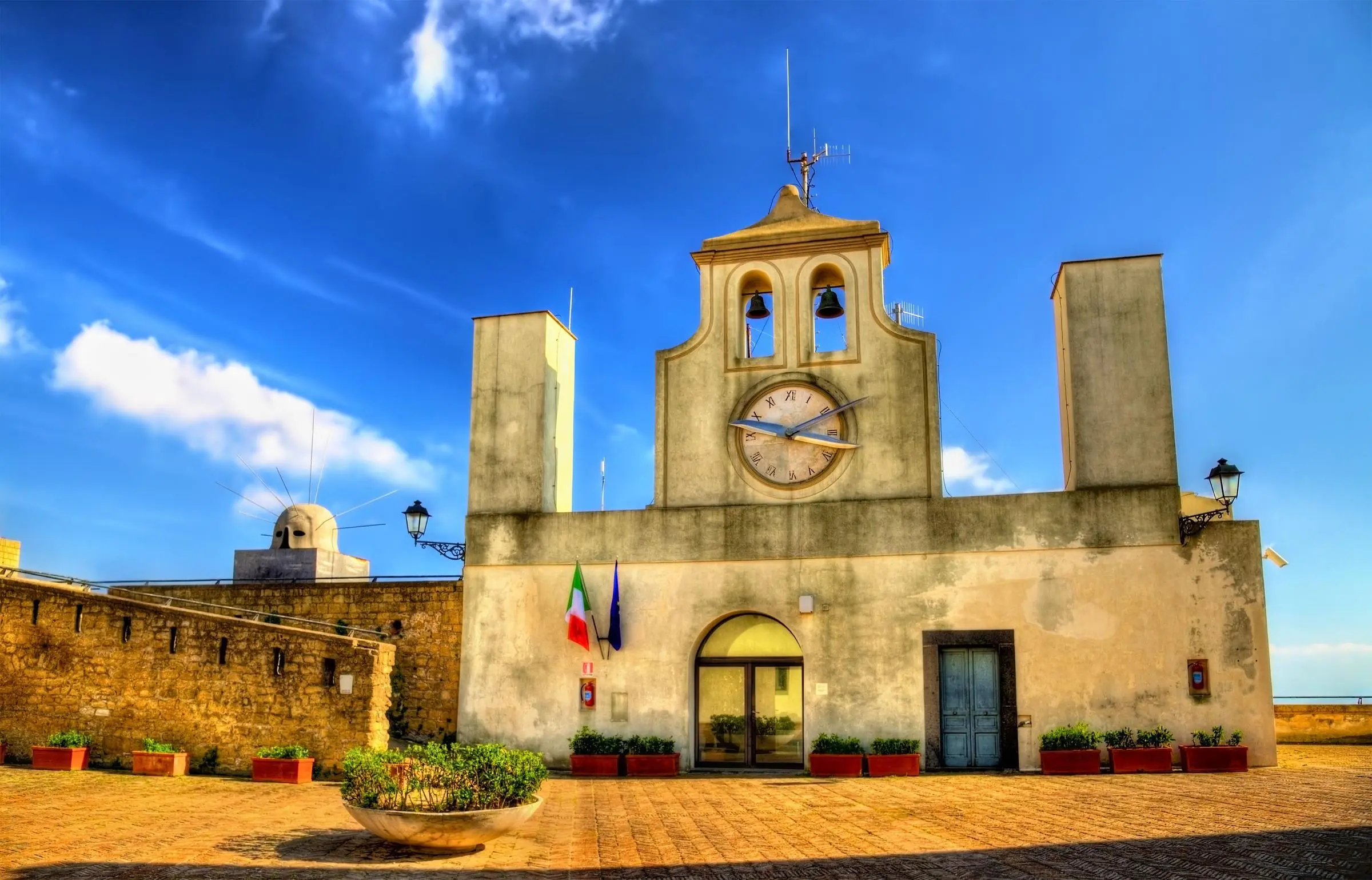
This wasn’t just for aesthetics; the star shape eliminated “blind spots.” Defenders standing on the points of the star could fire upon attackers approaching from any angle. As you walk the perimeter of the Piazza d’Armi (the vast parade ground at the top), notice the sheer thickness of the walls, which were designed to withstand heavy cannon fire.
2. The 360-Degree Panoramic Views
The primary reason to visit Castel Sant’Elmo is the view. Because it sits at the peak of Vomero Hill, the ramparts offer an unobstructed 360-degree panorama.
- Looking East: You will see the entire historic center. Look for the distinct, straight line of Spaccanapoli (literally “Naples splitter”), the ancient Roman road that slices the city perfectly in half. Beyond the city, the twin peaks of Mount Vesuvius dominate the horizon.
- Looking South: The Bay of Naples opens up, with the Sorrento Peninsula and the island of Capri visible on clear days.
- Looking West: You can see the affluent neighborhood of Posillipo and the volcanic Phlegraean Fields stretching out toward the sea.
3. The Moat and Drawbridge
Before you even reach the ticket scanners, you have to cross the castle’s moat. Unlike traditional European castles surrounded by water, Sant’Elmo’s moat is a dry, plunging trench carved directly into the yellow Neapolitan tuff rock. The bridge you walk across replaces the original wooden drawbridge. Looking down into the moat gives you a true sense of how impenetrable this fortress was to ground assaults.
4. The Prisons
Deep within the lower levels of the fortress are the old prison cells. Because of its secure location, Sant’Elmo was used as a military and political prison for centuries. Its most famous inmate was the philosopher Tommaso Campanella, who was imprisoned here in the early 1600s for heresy and sedition. It was shortly after his time in these damp, dark cells that he wrote his famous utopian work, The City of the Sun.
Later, during the short-lived Neapolitan Republic of 1799, many of the city’s revolutionary intellectuals were jailed here before being executed.
5. Museo Novecento (The Modern Art Museum)
Located in the former officers’ quarters building on the upper parade ground is the Museo del Novecento a Napoli. This museum is included in your entry ticket and is often entirely overlooked by visitors who just come for the views.
The museum chronicles the history of Neapolitan art from 1910 to 1980. It features over 170 works, including paintings, sculptures, and installations. You’ll find pieces representing Futurism, the Transavantgarde movement, and local responses to the social upheavals of the 20th century. It is also heavily air-conditioned, making it a perfect retreat if you are visiting during the sweltering summer months.
Ticket Options & Passes
Standard Entry & Audio Guide
- Includes skip-the-line entry to the castle and ramparts.
- Includes access to the Museo Novecento.
- Comes with a downloadable digital audio guide.
Sant'Elmo & San Martino Tour
- 2-hour guided tour in Italian.
- Covers both the fortress and the adjacent Certosa di San Martino.
- Ideal for history buffs wanting deep context.
Campania Artecard (3-Day)
- Includes free entry to your first 2 sites (Sant’Elmo can be one).
- Up to 50% off subsequent sites.
- Includes unlimited public transit (funiculars, metro, buses).
Practical Tips for Your Visit
The Walk Up: From the ticket office to the top ramparts, you have to walk up a long, spiraling internal ramp. It is atmospheric but steep. If you have mobility issues, ask the staff at the entrance to use the elevator, which goes directly to the Piazza d’Armi at the top.
Combine with Certosa di San Martino: Right next door to the castle is the Certosa di San Martino, a former Carthusian monastery that is arguably one of the most beautiful Baroque complexes in Italy. Since you have already made the effort to travel up Vomero Hill, you should absolutely visit both on the same day.
Food and Drink: There is a small cafe located at the top of the castle near the museum. While the coffee and snacks are slightly overpriced compared to the city below, the outdoor seating offers an incredible view. Alternatively, wait until you leave the castle and walk back toward the funicular; Via Scarlatti and Via Luca Giordano in Vomero are packed with excellent, reasonably priced cafes and restaurants.
Keep Planning: If you are using a tourist pass to access the castle, read our breakdown of the Campania Artecard to see how to maximize its value across the city.
Where to Stay: The Vomero Neighborhood
If you prefer a quieter, cleaner, and more upscale environment than the chaotic historic center, the Vomero neighborhood (where the castle is located) is an excellent place to base yourself. You get sweeping views, great shopping, and easy access to the rest of the city via the funiculars and Metro Line 1.
Frequently Asked Questions
How long does it take to visit Castel Sant'Elmo?
Most visitors spend between 1.5 to 2 hours at the fortress. This gives you enough time to walk the long ramp up to the top, do a full lap of the hexagonal ramparts for photos, and briefly browse the modern art museum.
Is there an elevator to the top of the castle?
Yes. While the main route involves walking up a steep, spiraling internal ramp, there is an elevator available for visitors with mobility issues or strollers. Ask the staff at the ticket desk to direct you to it.
Is Castel Sant'Elmo included in the Campania Artecard?
Yes, Castel Sant’Elmo is part of the state museum network and is included in the Campania Artecard. You can use it as one of your free entries or use it for a discounted ticket if you have already used your free slots.
Can I buy tickets at the door?
Yes, there is a physical ticket office at the entrance. However, during peak summer months and weekends, the line can get long. Buying a digital ticket in advance allows you to bypass the purchase line and go straight to the scanners.
Is the castle wheelchair accessible?
Partially. The elevator takes you to the upper parade ground (Piazza d’Armi) and the modern art museum. However, the actual defensive ramparts where the best views are located have uneven surfaces, some steps, and lack ramps in certain sections, making full navigation difficult for wheelchair users.
Are there bathrooms inside the fortress?
Yes, there are clean public restrooms located at the top of the castle, near the entrance to the Museo Novecento and the cafe.