
Anchoring the eastern edge of Piazza del Plebiscito, the Royal Palace of Naples (Palazzo Reale) is a massive 17th-century complex that served as the center of power for the Spanish, Bourbon, and Savoy dynasties. While many visitors to Naples focus heavily on the ancient ruins of Pompeii or the narrow alleys of the Centro Storico, the Royal Palace offers a direct look at the city’s era as a wealthy, independent European capital.
The palace is vast, but the primary visitor route focuses on the Historic Apartments (Appartamento Storico). Because it rarely sees the overwhelming crowds of the National Archaeological Museum, it is generally a straightforward and comfortable visit.
Here is how to navigate the palace, what to look out for, and how to fit it into your Naples itinerary.
Is the Royal Palace Right for Your Trip?
Depending on your travel style and constraints, here is how to approach the palace:
- For the Time-Poor: You can walk through the main highlights in about 45 to 60 minutes. If you are short on time, grab a skip-the-line entry ticket to bypass the box office queue, which occasionally backs up on weekend mornings.
- For Budget Travelers: The palace is included in the Campania Artecard. If you plan to visit multiple museums and use public transit, the Artecard 3-Day Pass usually pays for itself after your third attraction.
- For Families: The palace has wide corridors and large rooms, giving kids space to walk without feeling claustrophobic. However, there are many fragile, roped-off items. Strollers are permitted, but you will need to use the elevator to bypass the Grand Staircase.
While the Royal Palace rarely sells out weeks in advance, the ticket desk line can take 20–30 minutes on Saturday and Sunday mornings. Booking a digital ticket saves you time at the door. Check Availability
5 Highlights of the Royal Palace
The visitor route through the palace is strictly linear. You will move from room to room in a specific order, which makes navigation easy. Here are the five major focal points of the complex.
1. The Facade Statues of the Kings
Before you even buy a ticket, take a moment in Piazza del Plebiscito to look at the western facade. In 1888, King Umberto I of Savoy commissioned eight massive marble statues to fill the empty niches along the ground floor.
These statues represent the founders of the specific dynasties that ruled Naples over the centuries, arranged chronologically from left to right:
- Roger the Norman
- Frederick II of Swabia
- Charles I of Anjou
- Alfonso V of Aragon
- Charles V
- Charles III of Bourbon
- Joachim Murat
- Vittorio Emanuele II
Local Tip: Neapolitans have a long-running joke about the statues of Charles V, Charles III, and Murat. Based on their hand gestures, locals joke that Charles V asks, “Who peed on the ground?”, Charles III replies, “I don’t know anything about it,” and Murat points to himself saying, “It was me, so what?”

2. The Grand Staircase of Honor (Scalone d’Onore)
Your visit begins by ascending the Grand Staircase. Originally built in the 1600s, it was heavily modified after a fire in 1837. The architect Gaetano Genovese rebuilt it using pink and white marble, adding a massive skylight above.
The scale of the staircase was designed to intimidate visiting diplomats and showcase the wealth of the Kingdom of Naples. Notice the intricate stucco work and the large statues representing military virtues.
3. The Court Theater (Teatrino di Corte)
Located early in the apartment route, this small, private theater was designed by Ferdinando Fuga in 1768. It was built specifically for the wedding celebrations of King Ferdinand IV and Maria Carolina of Austria.
Because the wedding was planned quickly, the original statues lining the walls were made of papier-mâché rather than marble or plaster to save time. The theater features rich red velvet seating and a heavily gilded ceiling. It is a stark contrast to the massive public San Carlo Theatre located just next door.
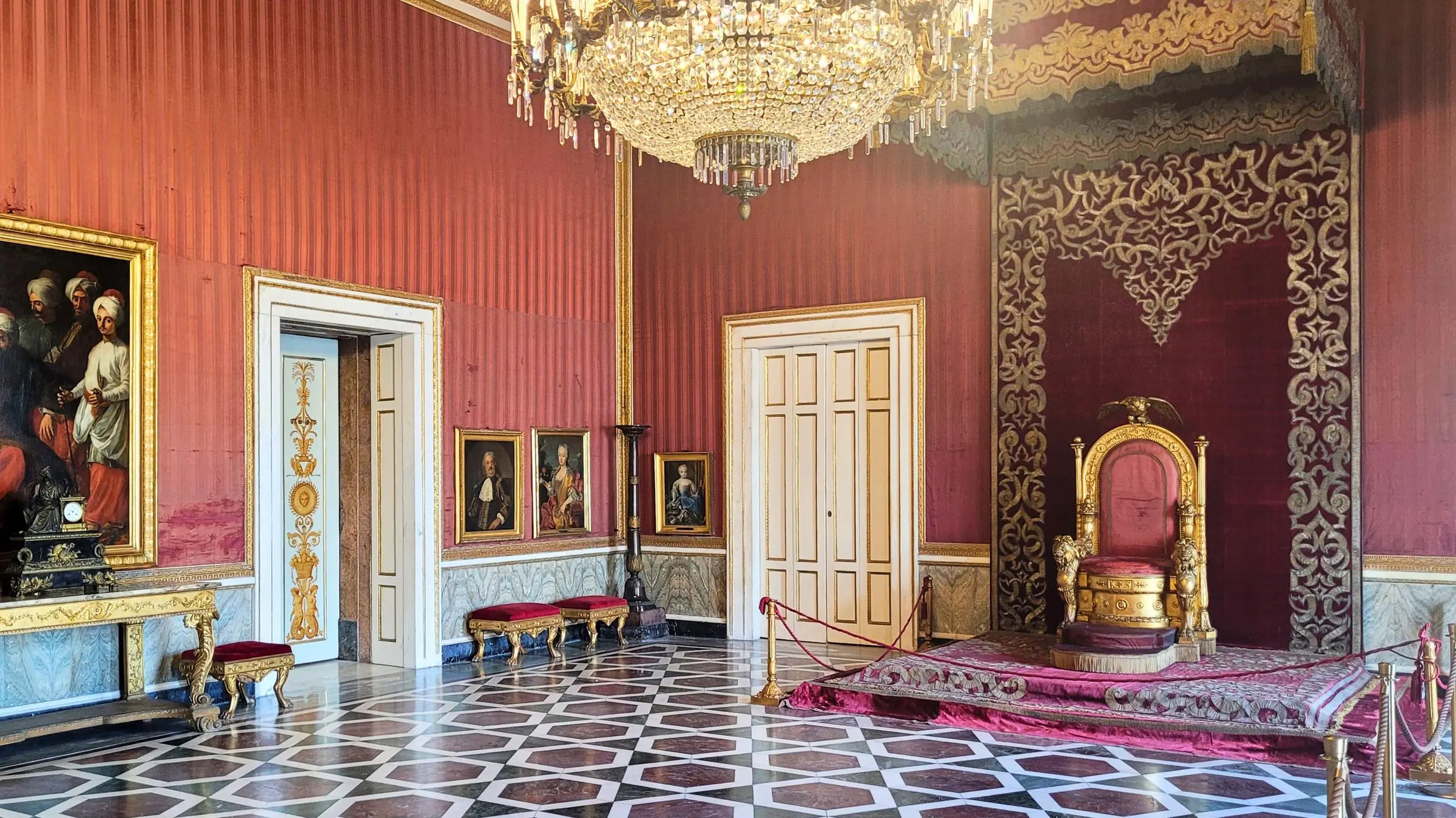
4. The Throne Room (Sala del Trono)
Room 39 is the political heart of the palace. The Throne Room is lined with red velvet walls featuring gold embroidery. The throne itself dates to the 1850s and sits beneath an elaborate canopy.
Look up at the ceiling to see a series of frescoes depicting the allegories of the provinces of the Kingdom of Naples. The room was designed to face the sea, allowing natural light to illuminate the king during official audiences.
5. The Royal Apartments
The bulk of your visit involves walking through the enfilade of the Royal Apartments. These rooms served as the private living quarters, dining rooms, and reception halls for the royal family.
Key rooms to watch for include:
- The Diplomatic Hall (Sala Diplomatica): Features massive tapestries and furniture from the Farnese collection.
- Maria Amalia of Saxony’s Boudoir: A room entirely decorated with Capodimonte porcelain, showcasing the output of the royal factory located up on Posillipo Hill.
- The Royal Chapel (Cappella Reale): A large, austere chapel that occasionally hosts temporary exhibitions today.
Proximity to the San Carlo Theatre
The Royal Palace is physically connected to the San Carlo Theatre, which is the oldest continuously active public opera house in Europe.
When King Charles III of Bourbon commissioned the theater in 1737, he insisted it be built adjacent to the palace. He had a private, enclosed corridor constructed so he could walk directly from his apartments to the royal box in the theater without having to step outside.
If you are planning your day, it makes logistical sense to visit the Royal Palace in the morning, grab a coffee at the nearby Galleria Umberto I, and then take a guided tour of the San Carlo Theatre in the afternoon.

Ticket Options and Tours
You can purchase tickets at the door, but buying in advance is recommended during the summer months and on weekends.
Royal Palace Entry + Audio Guide
- Skip the ticket desk line
- Includes a digital audio guide app
- Best for self-paced exploration
Royal Palace Small Group Tour
- 2-hour guided walking tour
- Includes entry ticket
- Provides historical context on the Bourbon dynasty
Campania Artecard (3-Day)
- Includes entry to the Royal Palace
- Includes 2 other major sites (e.g., Pompeii, MANN)
- Unlimited public transit in the region
Logistics & Practical Tips
How to Get There
The Royal Palace is located at Piazza del Plebiscito, 1.
- By Metro: Take Metro Line 1 to Toledo Station or Municipio Station. From either station, it is a flat, 10-minute walk to the palace.
- By Funicular: Take the Central Funicular down from Vomero to the Augusteo stop, then walk down Via Toledo to the piazza.
Local Tips for Your Visit
- Bag Storage: Large backpacks and umbrellas are not allowed in the historic apartments. There are free, secure lockers located near the ticket desk on the ground floor.
- Climate Control: The palace is a historic building and lacks modern, aggressive air conditioning in many of the rooms. If you are visiting in July or August, go right when it opens at 9:00 AM to avoid the midday heat.
- The Gardens: Your ticket includes access to the Royal Gardens (Giardini Pensili). They offer a quiet place to sit and provide excellent views of the Gulf of Naples and Mount Vesuvius.
- Accessibility: The palace is fully wheelchair accessible. There are elevators available to bypass the Grand Staircase.
Keep Planning: After visiting the palace, walk 5 minutes toward the water to explore Castel dell’Ovo and the restaurants along the Lungomare Promenade.
Where to Stay Nearby
The area immediately surrounding the Royal Palace (Piazza del Plebiscito, San Ferdinando, and the lower edge of Chiaia) is one of the safest, cleanest, and most upscale neighborhoods in Naples. It is an excellent base if you want to be close to the waterfront and high-end shopping, though it is further from the gritty charm of the historic center.
Frequently Asked Questions
How much time do I need to visit the Royal Palace of Naples?
Most visitors spend between 1 and 1.5 hours exploring the historic apartments and the grand staircase. If you plan to use the audio guide for every room and walk through the royal gardens, allow for 2 hours.
Is the Royal Palace included in the Campania Artecard?
Yes. The Royal Palace of Naples is included in the standard Campania Artecard network. You can use it as one of your free entries (on the 3-day pass) or for a 50% discount if you have already used your free entries.
Can I take photos inside the palace?
Yes, photography for personal use is permitted throughout the palace. However, the use of flash, tripods, and selfie sticks is strictly prohibited to protect the artwork and ensure the flow of foot traffic.
Is there a dress code for the Royal Palace?
There is no strict dress code for the Royal Palace (unlike some Italian churches). Casual wear, including shorts and sandals, is perfectly acceptable.
Does the palace have air conditioning?
The palace has limited climate control to protect the historic interiors. During peak summer (July and August), the upper apartments can get quite warm by the afternoon. Visiting in the morning is highly recommended.
Are there restrooms inside the palace?
Yes. There are clean, well-maintained restrooms located on the ground floor near the ticket office and locker area. Use them before ascending the Grand Staircase, as there are no public facilities along the apartment route.