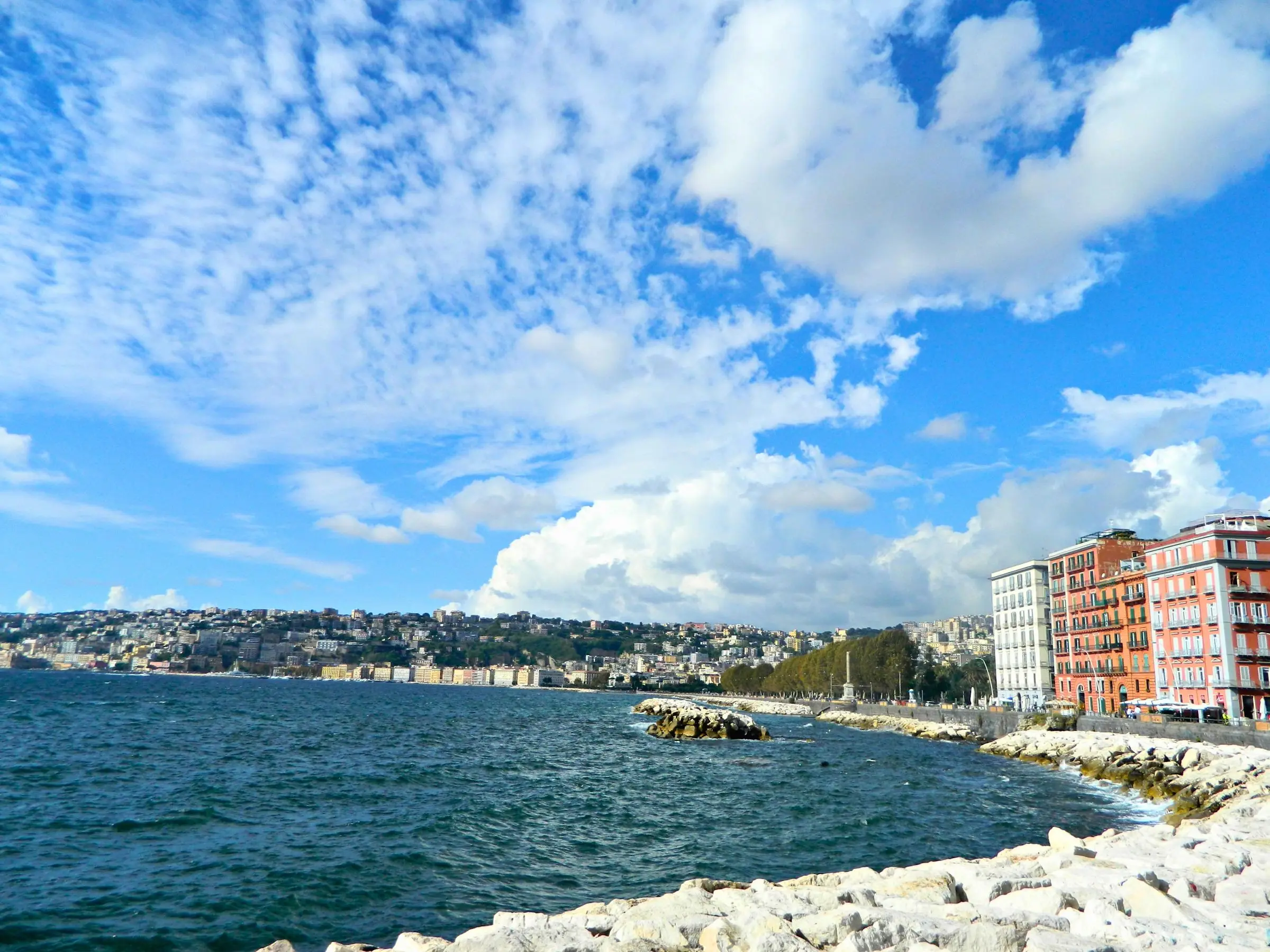
The Lungomare is Naples’ front porch. Stretching for roughly three kilometers along the Bay of Naples, this wide, breezy promenade is where the city comes to breathe. Made up primarily of two connecting streets—Via Francesco Caracciolo and Via Partenope—the route was fully pedestrianized in 2012, transforming it from a congested traffic artery into one of the most pleasant urban coastal walks in Europe.
If you have spent your morning dodging scooters in the narrow alleys of the historic center, the Lungomare provides an immediate sense of space. To your left, you have the grand architecture of the Chiaia and Santa Lucia neighborhoods; to your right, the dark blue waters of the bay, the looming silhouette of Mount Vesuvius, and the distant islands of Capri and Ischia.
This guide breaks down the 3-kilometer stretch, focusing on the specific highlights you will encounter, how to navigate the route, and what to expect from the local dining and recreation scene.
Who is the Lungomare Best For?
Because it is flat, paved, and free of cars, the promenade serves different travelers in different ways:
- Families with Children: This is one of the few places in central Naples where kids can run freely without the threat of traffic. The adjacent Villa Comunale park offers shade, playgrounds, and the historic Aquarium of Naples. If you want to break up the walk, grab an entry ticket to the aquarium to see local Mediterranean marine life.
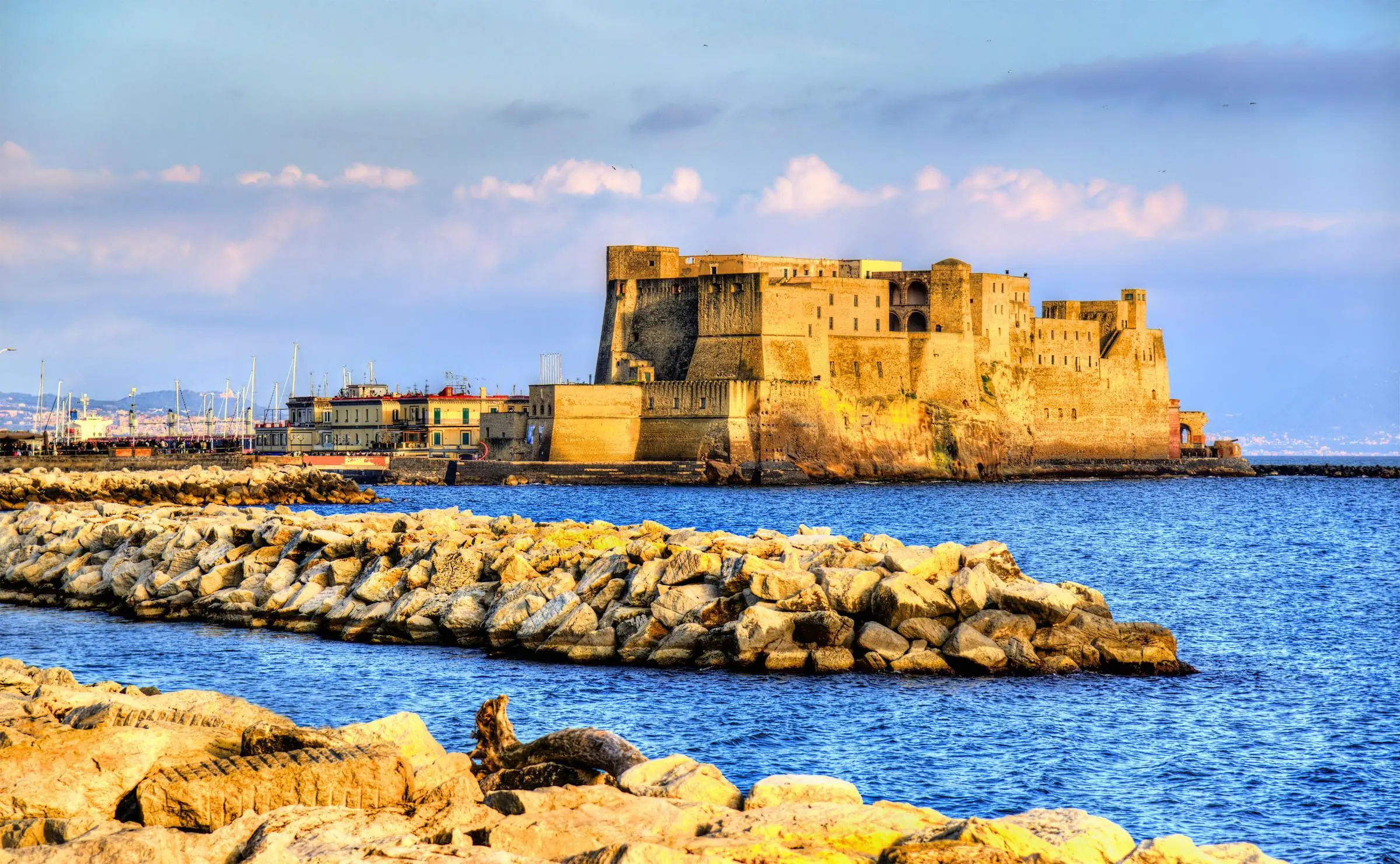
- Couples and Photographers: The light here is exceptional, particularly in the late afternoon. The stretch along Via Partenope, leading up to Castel dell’Ovo, provides the classic Naples postcard shot.
- Active Travelers: If you want to maintain a running routine while traveling, this is your spot. The flat, uninterrupted pavement is ideal for a morning 5K. You can also join a guided bike tour to cover the entire coastline efficiently.
There is virtually no shade on the promenade itself. If you are walking the Lungomare between May and September, do it before 10:00 AM or after 5:00 PM. Midday heat reflecting off the pavement can be intense.
5 Highlights of the Lungomare Promenade
1: The Uninterrupted Views of Vesuvius
The defining feature of the Lungomare is its orientation. As you walk east from Mergellina toward Santa Lucia, you are walking directly toward Mount Vesuvius.
Because the promenade hugs the curve of the bay, there are no buildings to obstruct your line of sight. The volcano dominates the horizon, serving as a constant, silent reminder of the region’s volatile geography. The view changes dramatically depending on the weather and time of day. In the morning, the sun rises behind the volcano, often casting it in a hazy silhouette. By late afternoon, the sun sets behind you (over the Posillipo hill), illuminating Vesuvius in sharp detail and turning the rock faces a deep, bruised purple.
Where to stop: The widest point of the promenade is at Rotonda Diaz (a large roundabout-turned-plaza). Stand near the equestrian statue of General Armando Diaz for a panoramic view that captures the bay, the volcano, and the Sorrento peninsula in a single frame.
2: The Luxury Hotel Facades of Via Partenope
As Via Caracciolo transitions into Via Partenope, the character of the street changes. The large public park (Villa Comunale) ends, and the inland side of the street is suddenly lined with some of Naples’ most historic and opulent hotels.
This stretch is the heart of the Santa Lucia neighborhood. You will walk past the grand facades of the Grand Hotel Vesuvio (where Enrico Caruso spent his final days) and the Hotel Excelsior. Built in the late 19th and early 20th centuries, these buildings feature ornate balconies, heavy stone masonry, and liveried doormen.
While you might not be paying €500 a night to stay in one of the sea-view suites, the ground floors of these hotels house elegant cafes. Stopping for an espresso or a Campari spritz here is pricey by Neapolitan standards (expect to pay €6 to €10 for a coffee), but you are paying for the front-row seat to the street’s theater and the bay beyond.
3: Rocky Beach Access Points
Naples is a coastal city, but it is not a traditional “beach town.” The shoreline along the Lungomare is heavily fortified with large boulders to protect the road from winter storm surges. However, locals make the most of what they have.
Mappatella Beach: Located right at Rotonda Diaz, this small crescent of dark, volcanic sand is the most accessible beach on the promenade. Historically, it was considered a gritty, working-class beach (the name “Mappatella” refers to the bundled cloth sacks people used to carry their lunches). Today, it is a bustling, democratic spot where locals set up umbrellas and folding chairs. The water here is calm, though it is a busy urban bay, so water quality varies.
The Rocks (Scogli): Further down, near the Castel dell’Ovo, you will see teenagers and sunbathers sprawled out directly on the massive breakwater boulders. It is not comfortable, and accessing the water requires careful climbing over slippery rocks, but it is a deeply authentic Neapolitan summer experience.
If you prefer to get out on the water rather than sit on the rocks, the small marina near the castle is the departure point for several coastal excursions. A boat tour of the gulf offers a completely different perspective of the promenade from the sea.
4: High-End Seafood Dining Terraces
The pedestrianization of Via Partenope sparked a restaurant boom. The street is now lined with massive outdoor dining terraces, covered by large white umbrellas and glass partitions to block the sea breeze.
This is where you go for upscale seafood, not cheap street food. Restaurants like Antonio & Antonio or Gino Sorbillo Lievito Madre al Mare (a slightly more upscale, sit-down version of the famous pizzeria) dominate the strip.
Borgo Marinari: For a more atmospheric dining experience, walk across the short stone bridge to Borgo Marinari, the tiny islet that houses Castel dell’Ovo. The marina here is packed with sailboats and surrounded by traditional seafood trattorias like Zi Teresa and La Bersagliera.
A word on quality: Because this is the prime tourist strip, you pay a premium for the view. A seafood pasta that costs €14 in the Spanish Quarters might cost €22 here. While the food is generally good, you are primarily paying for the ambiance. Always check if the fish is priced per 100 grams (often the case for fresh catches) to avoid a surprise bill.
Keep Planning: If you want to explore the city’s deeper culinary scene, read our guide on where to eat in Naples.
5: Sunday Roller-Skating and Cycling Culture
If you want to see the Lungomare at its most vibrant, visit on a Sunday morning. With the road entirely closed to vehicles, the wide asphalt becomes a playground.
You will see families renting multi-person pedal surreys, teenagers on rollerblades weaving through the crowds, and serious cyclists doing laps. Street performers, musicians, and balloon vendors set up along the sea wall. It is loud, chaotic, and joyful.
If you want to join in, there are several small kiosks near the Mergellina end of Via Caracciolo where you can rent bicycles by the hour. Alternatively, you can book a guided bike tour that uses the Lungomare as a safe, flat starting point before heading up into the hills of Posillipo.
A Suggested Walking Itinerary
To experience the full progression of the promenade, start at the western end and walk east.
The Classic Lungomare Walk
⏱️ Total: 1 h 30 minStart at Mergellina
Take Metro Line 2 to the Mergellina station. Walk down to the water. Here, the marina is full of small fishing boats and luxury yachts. Grab a coffee at one of the chalets (small kiosks) before starting your walk east along Via Caracciolo.
Villa Comunale & Rotonda Diaz
Walk with the sea on your right and the green gates of the Villa Comunale park on your left. Stop at Rotonda Diaz to watch the activity at Mappatella Beach and take photos of Vesuvius.
Via Partenope
As the park ends, the luxury hotels begin. The pavement narrows slightly, and the restaurant terraces take over. This is a great place to stop for a drink and people-watch.
Castel dell'Ovo & Borgo Marinari
The promenade culminates at the causeway leading to the 12th-century Castel dell’Ovo. Cross the bridge to explore the tiny, atmospheric Borgo Marinari marina.
Practical Logistics
How to Get There
The Lungomare is long, so your starting point dictates your transit options.
- Western End (Mergellina): Take Metro Line 2 to Mergellina. It is a 5-minute walk downhill to the water.
- Middle (Villa Comunale): Take Metro Line 2 to Piazza Amedeo, walk down through the Chiaia neighborhood, and cross through the park to the sea.
- Eastern End (Santa Lucia/Castel dell’Ovo): Take Metro Line 1 to Municipio or Toledo, and walk south past Piazza del Plebiscito.
Nearby Attractions
Because the Lungomare sits at the bottom of the city, it pairs well with attractions in the immediate vicinity. The Galleria Borbonica (Bourbon Tunnel) has an entrance on Via Morelli, just a block inland from the promenade. Booking a guided tour of the tunnels is an excellent way to escape the midday heat after walking the seafront.
Where to Stay Nearby
Staying near the Lungomare puts you in the safest, cleanest, and most upscale part of Naples. The Santa Lucia area (near the castle) is dominated by large, traditional luxury hotels. The Chiaia neighborhood, just one block inland from the promenade, offers excellent boutique hotels and B&Bs amid high-end shopping streets.
Frequently Asked Questions
Is the Lungomare safe to walk at night?
Yes. The Lungomare is one of the safest areas in Naples. It is heavily trafficked by locals and tourists well past midnight, especially in the summer. The restaurant terraces on Via Partenope keep the area brightly lit and busy.
Are there public restrooms along the promenade?
Public restrooms are scarce. Your best option is to buy a coffee or a bottle of water at one of the chalets (kiosks) or cafes and use their facilities.
Can you swim at the Lungomare?
Technically yes, at Mappatella Beach and off the rocks near Castel dell’Ovo. However, because this is an active urban bay near a major port, the water quality is not pristine. Most locals prefer to take a ferry to the islands or the Amalfi Coast for serious swimming.
How long does it take to walk the entire route?
Walking from the Mergellina port to Castel dell’Ovo takes about 45 minutes at a brisk pace. If you are strolling, taking photos, and stopping for gelato, allow for 1.5 to 2 hours.
Is the route wheelchair and stroller accessible?
Yes, the entire length of Via Caracciolo and Via Partenope is flat, paved, and free of curbs, making it highly accessible for wheelchairs and strollers.