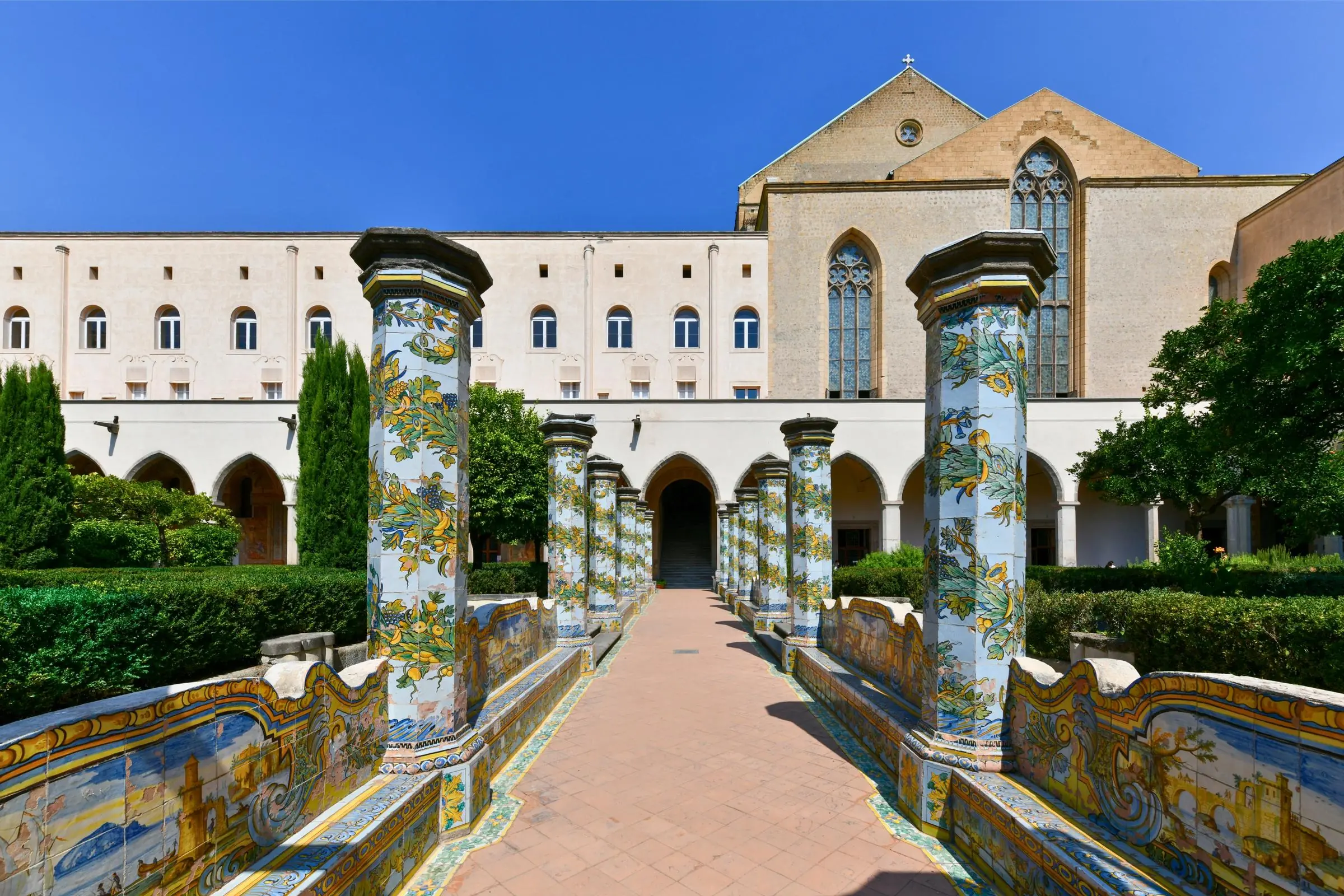
If you stand in the middle of Piazza del Gesù Nuovo, you are looking at one of the most jarring architectural contrasts in Naples. On one side sits the Monastero di Santa Chiara, a picture of austere, pale Gothic simplicity. Directly opposite stands the Chiesa del Gesù Nuovo, a dark, spiky, fortress-like structure that looks like it belongs in a medieval war zone rather than a religious square.
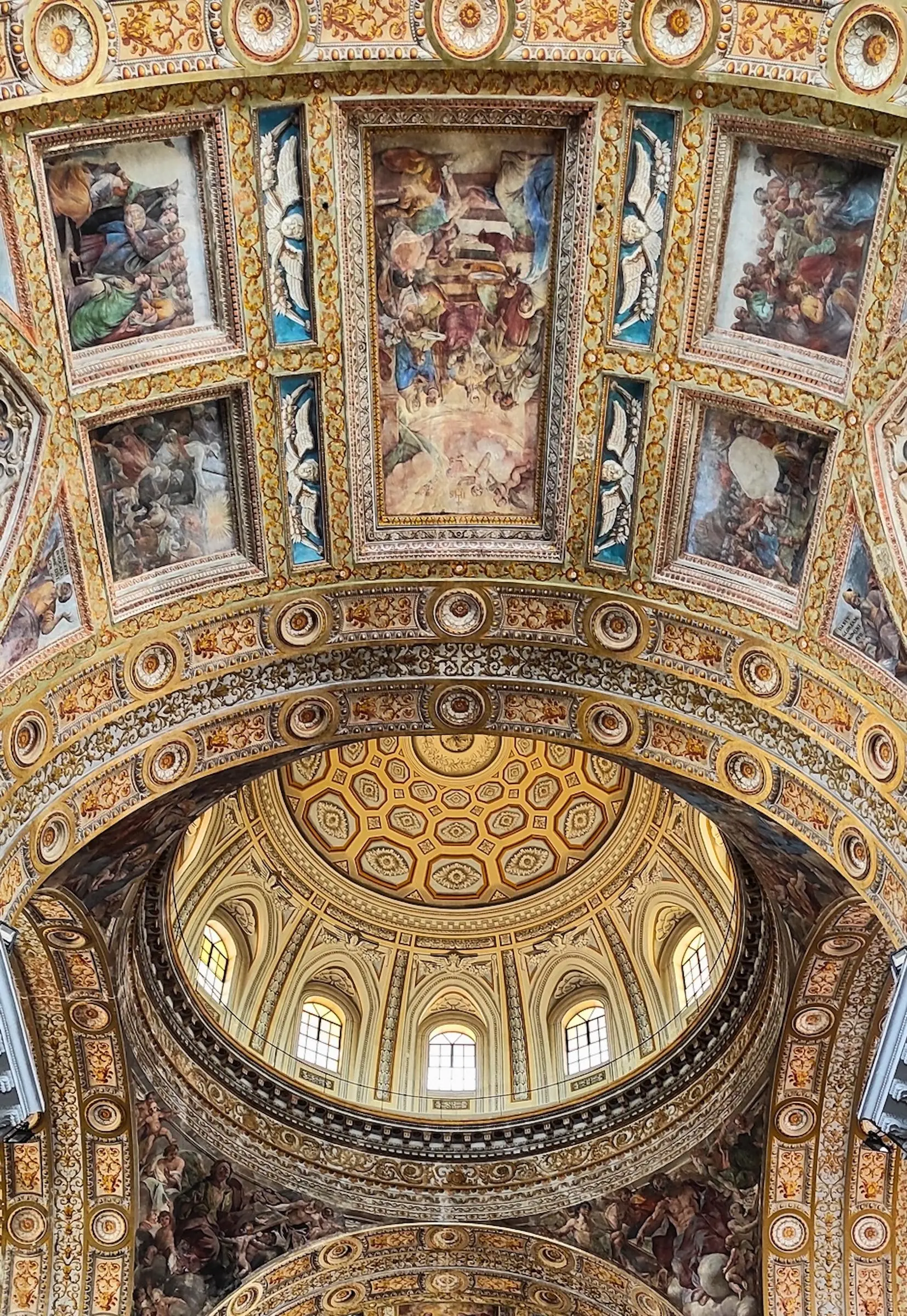
But walk through the heavy bronze doors of Gesù Nuovo, and the fortress illusion shatters. You are instantly hit with an overwhelming explosion of Neapolitan Baroque art—gold leaf, polychrome marble, massive frescoes, and swirling sculptures.
Because it sits right at the entrance to Spaccanapoli, almost every guided walking tour of the historic center stops here. However, to truly appreciate this building, you need to know what you are looking at. Here is how to navigate the facade’s secret codes, the overwhelming interior, and the fascinating modern history of the doctor buried inside.
Gesù Nuovo at a Glance
Entry Cost
- Entry to the church and the Moscati rooms is completely free.
- Donations are accepted in the ex-voto rooms.
Walking Tours
- Best experienced as part of a broader Old Town walking tour.
- Guides help decode the facade’s musical score.
5 Highlights of Gesù Nuovo
1. The Aragonese Diamond-Point Masonry
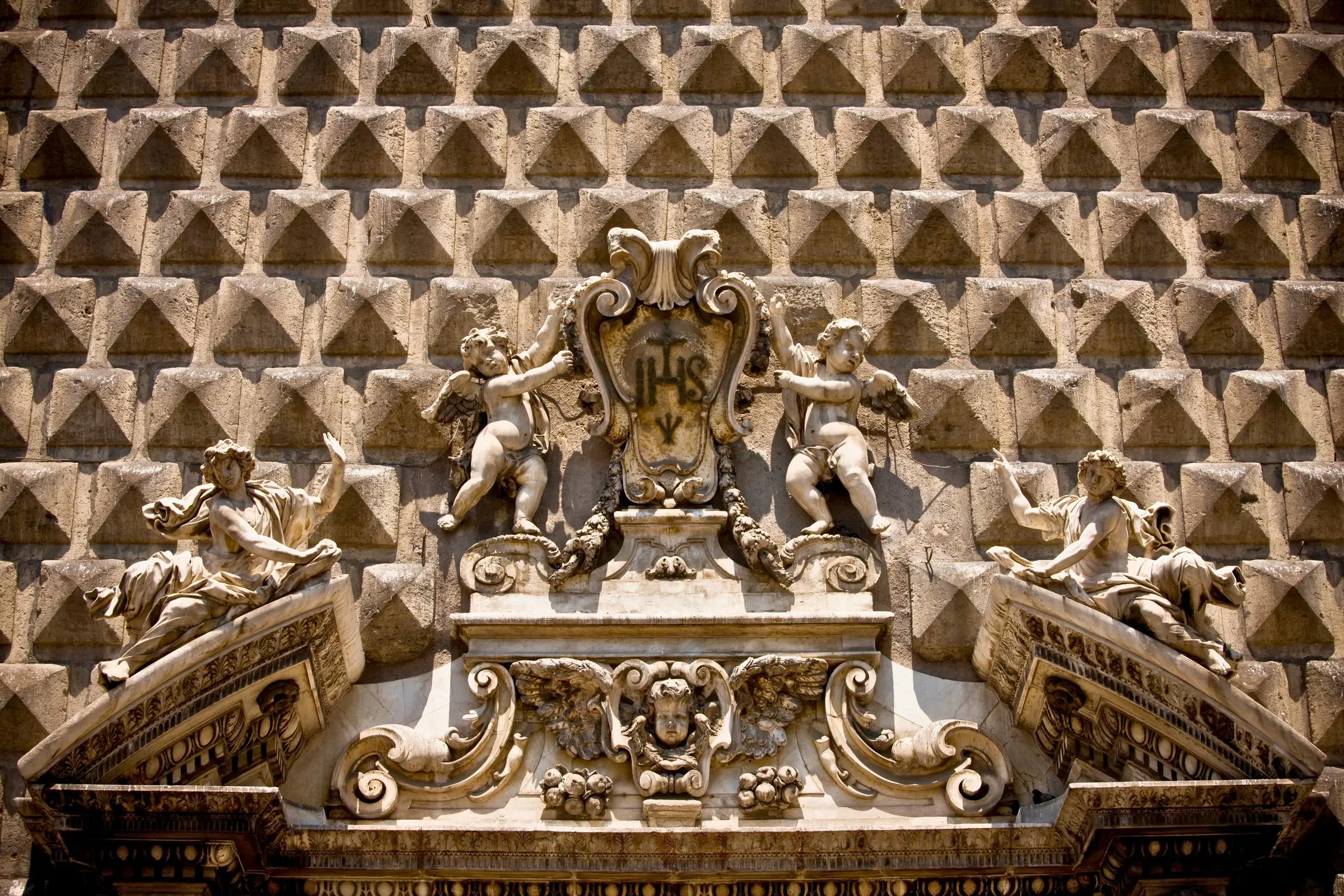
The church’s facade was never meant to be a church. It was originally built in 1470 as Palazzo Sanseverino, the grand home of the Prince of Salerno. The exterior is covered in bugnato a punta di diamante (diamond-point rustication)—dark piperno stones carved into sharp, projecting pyramids. When the Jesuits took over the confiscated property in the 1580s, they gutted the palace to build their church but kept the striking facade.
If you look closely at the stones, especially near the bottom, you will see strange symbols carved into the flat edges of the pyramids. For centuries, Neapolitans believed these were magical symbols or secret alchemical codes left by the Sanseverino family’s occultist builders.
The truth, discovered by art historians in 2010, is arguably more fascinating. The symbols are Aramaic letters representing musical notes. The entire facade is a giant Renaissance musical score. If you read the stones from right to left, bottom to top, they translate to a 45-minute piece of music for plucked string instruments.
Where to look: Stand to the left of the main central door and look at the stones at eye level. You will easily spot the deeply engraved, rune-like symbols on the flat facets of the stone pyramids.
2. The Explosion of Baroque Marble
Stepping inside Gesù Nuovo requires a moment of adjustment. The interior is designed on a Greek cross plan (four arms of equal length) and is entirely coated in polychrome marble.
This is the height of Neapolitan Baroque, largely orchestrated by the architect and sculptor Cosimo Fanzago in the 17th century. Unlike the quiet, contemplative stone of older Gothic churches, Gesù Nuovo was designed by the Jesuits to awe and overwhelm the congregation with the power and wealth of the Catholic Church during the Counter-Reformation. Look at the intricate marble inlay work (intarsia) on the walls and altars, where different colored stones are cut and pieced together like jigsaw puzzles to create floral and geometric patterns.
3. Francesco Solimena’s Counter-Facade Fresco
Before you walk too far down the nave, turn around and look up at the wall above the main entrance doors (the counter-facade). You will see a massive, chaotic, and brilliantly colored fresco.
This is The Expulsion of Heliodorus from the Temple, painted in 1725 by Francesco Solimena, one of the undisputed masters of the late Baroque era. The painting depicts the biblical story of Heliodorus being driven out of the temple in Jerusalem by a heavenly horseman after trying to steal its treasure. The swirling composition, dramatic lighting, and sheer scale of the piece make it one of the most important paintings in Naples.
4. The Silver Reliquaries & Chapels
As you walk around the perimeter, you will pass eleven side chapels. The most significant is the Chapel of St. Ignatius of Loyola (the founder of the Jesuit order), located in the right transept.
The chapel features statues of David and Jeremiah by Cosimo Fanzago, but the real draw is the collection of silver reliquary busts. Naples has a long tradition of silver-smithing (which you can explore further at the Treasure of San Gennaro), and the heavy, ornate silver busts here—containing the relics of various martyrs—are prime examples of 17th-century Neapolitan craftsmanship.
5. The Tomb of Dr. Giuseppe Moscati
In the right aisle, you will notice a chapel that is consistently crowded with locals praying, lighting candles, and leaving flowers. This is the tomb of St. Giuseppe Moscati (1880–1927).
Moscati was a pioneering doctor, medical researcher, and professor in Naples. He became famous for his diagnostic brilliance and his absolute dedication to the poor, often treating them for free and secretly slipping money into their prescriptions so they could afford food. He was canonized by Pope John Paul II in 1987.
Adjacent to the church, you can visit the “Moscati Rooms.” These rooms contain a recreation of his medical office, his personal effects, and walls covered head-to-toe in ex-votos—silver hearts, lungs, limbs, and framed photographs left by people who believe Moscati miraculously cured them or their loved ones. It is a profound look into modern Neapolitan faith.
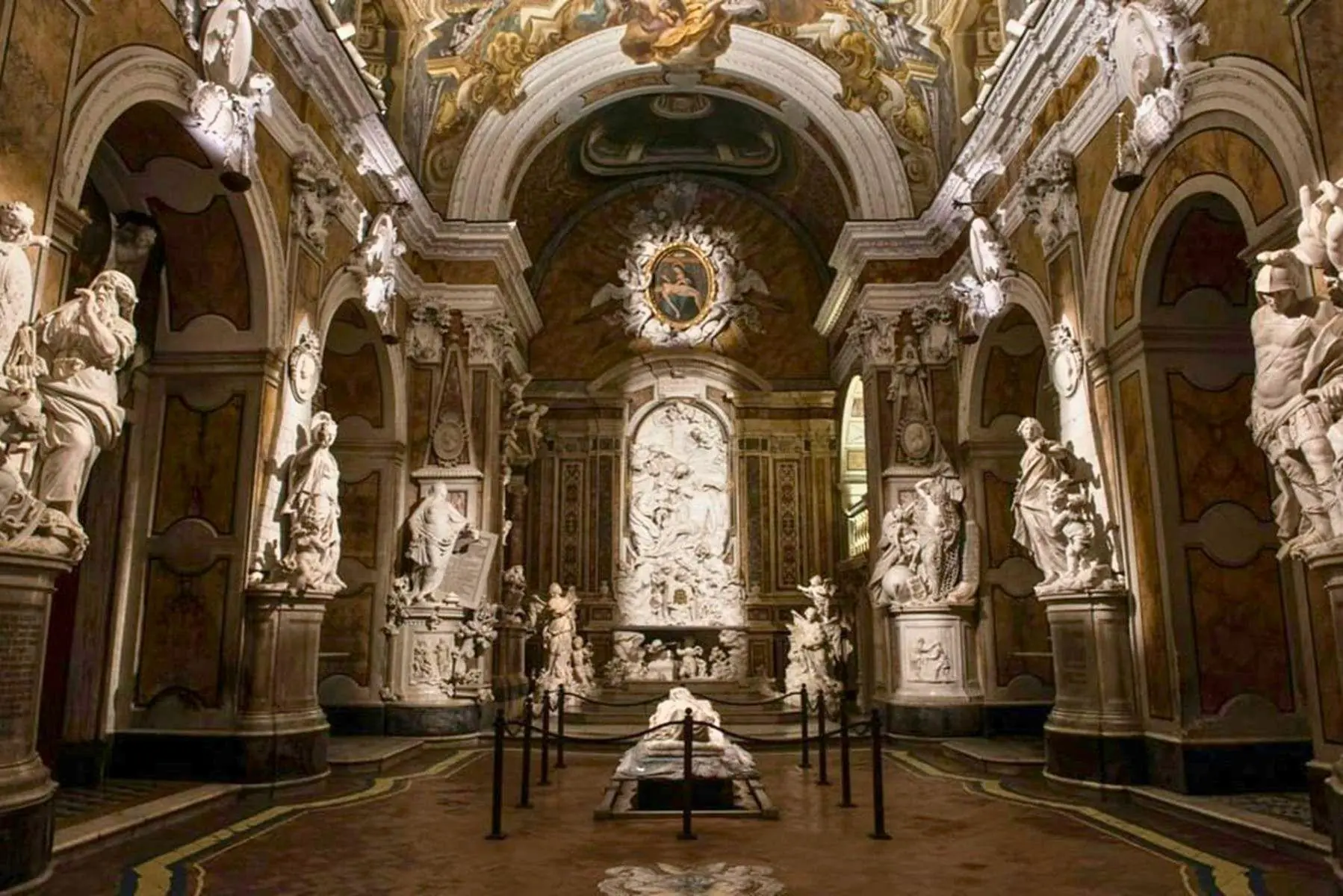
Gesù Nuovo is just a 5-minute walk from the famous Sansevero Chapel. While Gesù Nuovo is free and requires no booking, the Veiled Christ sells out days in advance. If you want to see both, book a walking tour including Santa Chiara and the Veiled Christ to secure your entry.
Advice for Different Types of Travelers
For the Time-Poor
If you only have 15 minutes to spare while walking down Spaccanapoli, you can still experience the best of Gesù Nuovo.
- Spend 2 minutes outside looking at the diamond-point stones.
- Walk inside, turn around immediately to see the Solimena fresco.
- Walk up the right aisle to see the bronze tomb of Giuseppe Moscati.
- Exit and continue your walk.
For Families with Kids
Children usually find traditional churches boring, but Gesù Nuovo has two great “hooks.” First, tell them about the secret musical code carved into the spiky stones outside—it turns the facade into a giant puzzle. Second, take them to the Moscati ex-voto rooms. The walls covered in thousands of silver body parts and old photographs are visually fascinating and offer a tangible way to explain local history and traditions.
For Budget Travelers
Gesù Nuovo is a functioning Catholic church, meaning entry is 100% free. You do not need a ticket to see the main nave, the chapels, or the Moscati rooms. It is one of the best free art experiences in the city. Just remember to bring a few 50-cent coins if you want to illuminate specific chapels (many Italian churches use coin-operated light boxes to preserve the art).
Logistics: How to Visit
Getting There
Gesù Nuovo is located in Piazza del Gesù Nuovo, which marks the western beginning of the famous Spaccanapoli street (officially Via Benedetto Croce at this point).
- By Metro: Take Metro Line 1 to the Dante station. Walk south down Via Toledo for about 5 minutes, then turn left into Piazza del Gesù Nuovo.
- Walking: If you are already in the Centro Storico, simply follow Spaccanapoli westward until it opens up into the large piazza with the towering obelisk.
Opening Hours
Like many non-tourist-ticketed churches in Italy, Gesù Nuovo closes in the middle of the day.
- Morning: 8:00 AM – 13:00 (1:00 PM)
- Afternoon: 16:00 (4:00 PM) – 19:30 (7:30 PM)
- Note: The church is active. Avoid wandering around with a camera during Sunday Mass.
The Midday Closure: Do not plan to visit between 1:00 PM and 4:00 PM. The heavy bronze doors will be shut tight. Use this time to get lunch at a nearby pizzeria or visit the Santa Chiara Cloister across the square, which stays open through the afternoon.
Dress Code
Because it is an active place of worship, standard Italian church dress codes apply. Shoulders and knees should be covered. If you are visiting in the peak of summer, keep a lightweight scarf in your bag to throw over your shoulders before walking in.
A Perfect 2-Hour Spaccanapoli Itinerary
If you want to cluster your sightseeing, Piazza del Gesù Nuovo is the perfect starting point for a morning in the historic center.
The Spaccanapoli Starter Route
⏱️ Total: 2 hGesù Nuovo
Start at 9:30 AM. Inspect the diamond-point facade, then head inside to see the Baroque interior and the Moscati rooms.
Santa Chiara Cloister
Cross the piazza and enter the Monastero di Santa Chiara. Pay the entry fee to see the stunning majolica-tiled cloister, a peaceful oasis of lemon trees and colorful ceramics.
Walk Spaccanapoli to San Domenico
Leave Santa Chiara and walk straight down Spaccanapoli. You will pass traditional pastry shops (grab a sfogliatella). Stop at Piazza San Domenico Maggiore to see the obelisk and the San Domenico Maggiore church.
Keep Planning: If you want a local expert to guide you through this exact route and explain the layered history, check out our guide to the best walking tours in the city, or book a comprehensive Old Town walking tour.
Where to Stay Nearby
Piazza del Gesù Nuovo is one of the best areas to base yourself in Naples. You are right on the edge of the historic center (meaning you can walk to all the major sights), but you are also just one block away from Via Toledo and the Dante Metro station, making it easy to escape the narrow alleys when you want to visit Mount Vesuvius or the National Archaeological Museum.
Use the map below to find hotels and guesthouses right around the piazza.
Frequently Asked Questions
Is there an entry fee for Gesù Nuovo?
No, entry to the church, the side chapels, and the rooms dedicated to Dr. Giuseppe Moscati is completely free. You may want to bring small coins to operate the lighting boxes for the frescoes.
What is the music carved on the outside of the church?
The Aramaic letters carved into the diamond-point stones on the facade form a Renaissance musical score. It is a 45-minute piece meant to be played on plucked string instruments, reading the stones from right to left, bottom to top.
How long does it take to visit?
If you just want to see the main nave and the architecture, 15 to 20 minutes is plenty. If you want to explore the Moscati rooms and read the history, allow 30 to 45 minutes.
Who was Giuseppe Moscati?
Dr. Giuseppe Moscati was a Neapolitan physician and medical researcher in the early 20th century. He was famous for his diagnostic skills and his immense charity, often treating the poor of Naples for free. He was canonized as a saint in 1987.
Is Gesù Nuovo air-conditioned?
No. Like most historic churches in Naples, there is no air conditioning. However, the thick stone walls and high ceilings mean the interior is usually significantly cooler than the piazza outside, making it a great place to escape the midday heat (before they close at 1:00 PM).
Can I take photos inside?
Yes, photography without flash is generally permitted. However, you should not take photos during Mass, and you should be respectful in the Moscati chapel, as it is a place of active, deep prayer for many locals.