Naples is overwhelmingly known for its dramatic, heavy Baroque architecture. But sitting quietly on Piazza Monteoliveto, just a short walk from the bustling Via Toledo, is a rare slice of the Tuscan Renaissance. St. Anne of Lombardi (officially known as Sant’Anna dei Lombardi or Santa Maria di Monteoliveto) is one of the most historically significant churches in the city.
From the outside, the church’s plain facade gives nothing away. Inside, however, it holds a staggering collection of 15th and 16th-century art. Because it sits slightly off the main tourist artery of Spaccanapoli, it rarely sees the massive crowds that flock to the Sansevero Chapel. If you want to see world-class frescoes and incredibly realistic terracotta sculptures without standing shoulder-to-shoulder with tour groups, this is where you go.
This guide breaks down exactly how to navigate the complex, what to look for in its five main highlights, and how to fit it into your Naples itinerary.
Is St. Anne of Lombardi Right for You?
Before you buy an Entry Ticket + Audio Guide, it helps to know if this specific church aligns with your travel style.
- For Art and History Lovers: This is a non-negotiable stop. The presence of Tuscan masters like Benedetto da Maiano, Antonio Rossellino, and Giorgio Vasari in Naples is highly unusual. You will want to allocate at least 90 minutes to study the chapels and the wooden intarsia.
- For the Time-Poor: If you only have 30 minutes, you can still make it work. Head straight to the back right of the church to see Vasari’s Old Sacristy and Mazzoni’s Lamentation. These two highlights alone justify the entry fee.
- For Budget Travelers: At around €8, the entrance ticket is highly affordable compared to other major European art sites, and it includes a digital audio guide that provides excellent context.
- For Families with Kids: While younger children might not appreciate the Renaissance architecture, the life-sized, highly expressive terracotta statues in the Lamentation and the slightly spooky underground crypt usually hold their attention.
While Sant’Anna dei Lombardi doesn’t sell out weeks in advance like some Naples attractions, the small ticket desk inside the entrance can get backed up during peak morning hours. Booking your Entry Ticket + Audio Guide on your phone saves you from waiting behind large school groups.
The 5 Highlights of the Complex
The church layout can be slightly confusing because it was expanded and modified several times by the Aragonese kings of Naples. Here are the five specific areas you need to focus on.
1. The Old Sacristy (Vasari’s Frescoes)
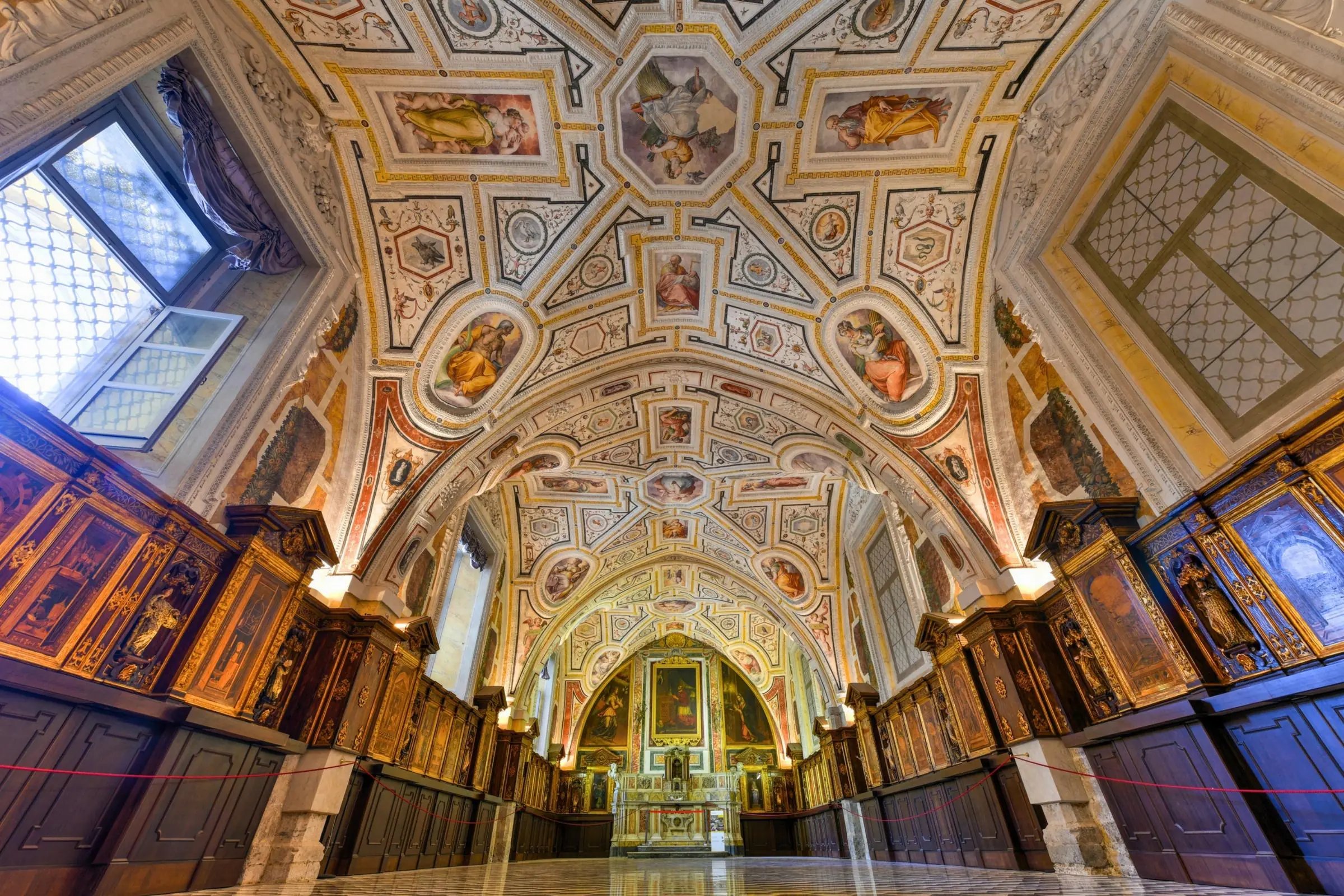
Often referred to locally as a “mini Sistine Chapel,” the Old Sacristy is the undisputed star of the complex. In 1544, the monks commissioned Giorgio Vasari (famous for writing The Lives of the Artists) to paint the refectory.
Vasari initially refused the job. The room was built in a dark, heavy Gothic style, and he felt it lacked the light necessary for his work. To fix this, he had the ceiling whitewashed and covered it in bright, vibrant frescoes divided into geometric panels. The ceiling is a riot of color, featuring allegories of virtues, constellations, and intricate grotteschi (grotesque) motifs.
What to look for: Stand in the center of the room and look at the wooden panels lining the walls. The contrast between the dark, intricate wood and the explosive colors of Vasari’s ceiling is intentional and highly effective.
2. The Lamentation over the Dead Christ (Guido Mazzoni)
Located in the Oratory of the Holy Sepulchre on the right side of the complex, this 1492 terracotta sculptural group by Guido Mazzoni is startling in its realism. Unlike the idealized, serene marble faces typical of the Renaissance, Mazzoni’s figures are raw, ugly, and visceral.
The group depicts the moments after Christ is taken down from the cross. The life-sized figures surround the body, their faces contorted in genuine grief, mouths open in mid-wail, and hands wringing.
What to look for: The figures were modeled after real people from the Neapolitan royal court. The man representing Joseph of Arimathea (standing on the far right) is widely believed to be a portrait of King Alfonso II of Naples. The realism of the clothing and the deep wrinkles in the faces make this one of the most powerful pieces of art in the city—and a frequent highlight on a Naples guided sculpture tour.
3. The Intricate Wooden Choir Stalls
When you visit the Old Sacristy, pay close attention to the wooden panels lining the lower half of the walls. These were created by Fra Giovanni da Verona between 1506 and 1510.
This is intarsia—wood inlay. The artist used different natural shades of wood, cut into tiny pieces, to create flat images that look three-dimensional. The panels depict cityscapes, birds, musical instruments, and geometric shapes with perfect perspective.
What to look for: Look at the panels depicting half-open cabinets. The optical illusion is so convincing that you will find yourself wanting to reach out and close the wooden doors.
4. The Renaissance Chapels (Piccolomini & Tolosa)
The front half of the church houses several chapels that look like they were airlifted directly out of Florence. The Aragonese kings brought Tuscan architects and sculptors to Naples to show off their wealth and modern taste.
- The Piccolomini Chapel: Designed to mimic the famous Chapel of the Cardinal of Portugal in Florence. It features a stunning marble tomb carved by Antonio Rossellino and Benedetto da Maiano.
- The Tolosa Chapel: A perfectly proportioned Renaissance space that heavily references the work of Filippo Brunelleschi.
5. The Crypt (The Hypogeum)
Beneath the high altar lies a small, fascinating crypt. Like many underground spaces in Naples (such as the Catacombs of San Gennaro or the Fontanelle Cemetery), this area deals directly with the Neapolitan cult of the dead.
The Scolatoi: Inside the crypt, you will see stone niches with seats that have holes in them. These are scolatoi (drainers). Historically, bodies of monks or nobles were placed sitting up in these niches so their fluids could drain away as they decomposed, leaving only the bones to be collected and preserved. It is a stark reminder of historical burial practices.
Suggested Walking Route (1 Hour)
To make the most of your entry ticket, follow this logical flow through the complex so you don’t miss anything tucked away in the back corridors.
Navigating Sant'Anna dei Lombardi
⏱️ Total: 1 hThe Front Chapels
Start near the entrance. Walk into the initial chapels on the left and right to view the Piccolomini and Tolosa chapels. Take your time looking at the intricate Florentine marble carving on the tombs.
The High Altar & Crypt
Move down the single nave to the front of the church. Admire the 16th-century marble sculptures around the altar, then look for the stairs leading down into the hypogeum (crypt) to see the scolatoi.
Mazzoni's Lamentation
Head down the passage on the right side of the nave to find the Oratory of the Holy Sepulchre. Spend time looking at the individual faces of the terracotta figures in the Lamentation.
Vasari's Old Sacristy
Finish your visit in the Old Sacristy right next door. Grab a seat on one of the benches if available, look up at the frescoes, and then walk the perimeter to inspect the wooden intarsia panels.
Ticket Options and Logistics
Visiting the complex is straightforward, but knowing your ticket options can save you a few euros, especially if you are planning to visit multiple museums in Naples.
Admission Prices
- Standard Adult Entry: €8.00 (Includes a downloadable audio guide).
- Reduced Entry: Available for students and seniors (usually purchased on-site with ID).
St. Anne of Lombardi Ticket
- Skip the ticket purchasing line
- Includes digital audio guide
- Instant mobile ticket delivery
Sant'Anna dei Lombardi Complex
- Standard entry ticket
- Good backup if other platforms are down
- Free cancellation up to 24 hours before
Using City Passes
If you are using the Campania Artecard, St. Anne of Lombardi is often included in the discounted tier (meaning you get a reduced entry fee, though usually not free entry). You will need to show your active pass at the physical ticket desk to claim the discount.
How to Get There
The church is located at Piazza Monteoliveto, 4.
- By Metro: Take Metro Line 1 to the Toledo station (take the Monteoliveto exit if open, or walk north up Via Toledo for about 4 minutes and turn right toward Piazza Monteoliveto). You can also take Line 1 to the Dante station and walk 5 minutes south. The church sits right behind the large bronze fountain of King Charles II.
- On Foot: It is a very easy 5-minute walk down Calata Trinità Maggiore from the Gesù Nuovo Church and the Santa Chiara Cloister.
Opening Hours
- Monday to Saturday: 9:30 AM – 6:30 PM (hours can close earlier at 5:00 PM in winter)
- Sunday: 12:30 PM – 5:30 PM (morning hours are often reserved for mass)
- Note: Last entry is 30 minutes before closing. Because this is an active church, tourist access may be restricted during weddings or special religious services.
Keep Planning: If you enjoy underground history like the crypt here, check out our guide to Naples Underground or book a Galleria Borbonica guided tour to see the Bourbon Tunnel.
Where to Stay Nearby
Piazza Monteoliveto sits right on the border between the bustling Via Toledo shopping district and the dense, historic Spaccanapoli area. Staying near here puts you within walking distance of almost every major site in the city center, as well as the ferry port for trips to Capri or Ischia.
Use the map below to find hotels and guesthouses within walking distance of the church.
Frequently Asked Questions (FAQ)
How long does it take to visit St. Anne of Lombardi?
Most visitors spend between 45 minutes and 1 hour inside. If you are using the audio guide and taking time to study the details of the wooden choir stalls and the chapels, allow up to 90 minutes.
Is there a dress code for the church?
Yes. Because it is an active Catholic church, standard Italian church dress codes apply. Shoulders and knees should be covered. If you are visiting in the summer, bring a light scarf or shawl to throw over your shoulders before entering.
Is the complex wheelchair accessible?
The main nave of the church and the side chapels are generally accessible. However, the Old Sacristy has a few steps leading into it, and the underground crypt is only accessible via a narrow staircase, making it inaccessible for wheelchair users.
Can I take photos inside?
Yes, photography without flash is permitted throughout the complex, including inside the Old Sacristy and the crypt. Tripods and professional lighting setups require prior permission from the church administration.
Do I need to book tickets in advance?
It is not strictly mandatory, as the church rarely hits capacity. However, booking your Entry Ticket online allows you to bypass the ticket desk, which can occasionally get bogged down by large school groups or guided tours purchasing tickets on-site.
How does this compare to the Sansevero Chapel?
They are very different experiences. The Sansevero Chapel is famous for its late-Baroque marble masterpieces (like the Veiled Christ) and is heavily crowded, requiring advance booking. St. Anne of Lombardi is a quiet, spacious Renaissance complex focused on frescoes and terracotta. Both are highly recommended, but St. Anne is much easier to visit on a whim.